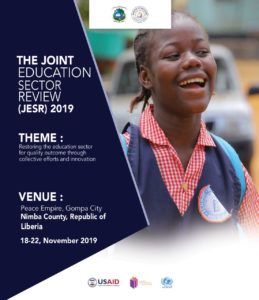

Gompa City, Nimba County – the Ministry of Education, along with partners and education stakeholders, continued with day-two of the Joint Education Sector Review. The day’s activities build on gains from the first day with a continuous focus on county education perspectives, to solicit recommendations, and to solidify actions to strengthen County Education Systems.
After a quick recap of day one’s activities, the event began with a motivational presentation by Mr. Dave G. Saceda, Chair and Founder of Saceda Youth Lead (YSL), an organization that establishes Youth Leadership initiatives to schools and universities in the Philippines and ASEAN region, on the theme of Incentivizing Teachers for Better Learning Outcomes, Strategies and Impact. Mr. Saceda stressed the importance of heroes in society and that our blindness to them is a result of us not bothering to look. He then described two types of heroes, the recognized heroes, “who shine in the face of great adversity”, and the unrecognized heroes who live among us, “who do their work unceremoniously, unnoticed by many of us, but who make a difference in the lives of others”. He ended by stating that heroes should not necessarily be judged by the result of their actions, but by their determination, sacrifice, and will that lives on for others to follow.
Following the motivational speaker, Senator D. Gueh, the chairman of the Senate Committee on Education, made several remarks, including a promise to declare education a national security emergency in forthcoming discussions with his colleagues and Government. He emphasized the enforcement of the Education Reform Law in expanding fiscal space for increased Educational funding. The senator emphasized the need for Teacher’s Licensing, similarly to what the honorable Minister of Education, Prof. Sonii, Sr. has stressed as a target of his administration; this he highlighted would improve the delivery of effective classroom instructions and how critical this is for the Liberian Education System.
Other presentations included the USAID Director of Education, Rasheena Harris, who urged participants to openly and honestly discuss the challenges of this year’s JESR in order to collectively solve these bottlenecks, with the hope that this will lead to better learning environment for Liberian children. The Mission Director also spoke of some noticeable challenges observed during the implementation of USAID interventions at the school level, such as teachers’ absenteeism, classroom over-crowdedness, etc. These are issues that have lingered in the education sector for which the current administration of the MoE has taken swift measures to curtail, including re-demarcating the educational districts, thereby reducing the number of assigned schools to District Education as well as providing resources to facilitate mobility which improves monitoring and supervision.
Additionally, a representative from READ Liberia, Ms. Patience Suah presented on the importance of early grade reading for one’s social development, with a focus on promoting good reading habits among children at an early stage of learning; highlighting that early reading increases a child’s social status, improves grammar in speaking and reading, builds foundational literacy skills and makes children more likely to succeed at schools.
Finally, there were county-level presentations on the progress of achievements of the Operational Plans for Bomi, Bong, Grand Gedeh, Grand Kru, Lofa, Margibi, Maryland, Nimba, and Sinoe after which participants were given a chance to interact with sets of panelists during the Questions & Answers sessions in an effort to provide clarity on important issues with a focus on county education perspectives, to solicit recommendations and to solidify actions to strengthen County Education Systems.
MoE, partners, and stakeholders will next, center attention to assessing the progress made in the Operational Plan 2018/2019, identifying challenges and making recommendations to ensure effective implementation for the coming years.
~END~
For inquiry, call 1416 or email contact@moe.gov.lr