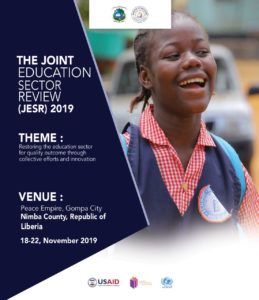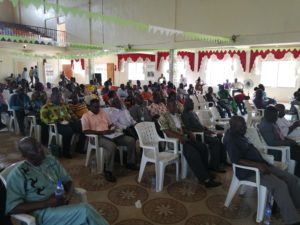

Gompa City, Nimba County – the Ministry of Education, along with partners and education stakeholders, continued with day-three of the Joint Education Sector Review. The day’s activities built on gains from the first two days by assessing progress made in the Operational Plan 2018-2019, identifying challenges, and making recommendations to ensure smooth implementation of priority areas.
Customarily, the day began with a quick recap of day two’s activities, proceeded by a presentation by Assistant Minister Hon. James Armah Massaquoi and Assistant Minister Hon. Dominic N. Kweme on Domestic and International Expenditure on Education, which provided a broad overview on educational spending by donor partners and by program areas. The presentation emphasized the challenge of expenditure data collection and gathering amongst implementing partners and highlighted MoE’s efforts to strengthen data coordination and management through its Donor Coordination Unit. The presenters disclose efforts that are put in place the Debt Management team from the Ministry of Finance and Planning, in collaboration with line Ministries and Agencies, in developing a system for the collection of (spending) data from its partners that will enable the Ministry of Education, amongst others, to expedite and standardize its data collection process.
As part of the motivational speakers of the day’s event, Mr. Stevenson Seidi, Liberia Country Representative of UNESCO spoke on STEM and Innovation, Approaches, Adaptation and Sustainability for Low-income Countries, putting forward the idea that innovation is needed to promote STEM education in Liberia. He further declared that the Liberian education sector should not exist without STEM since Liberia’s burgeoning, vibrant and youthful population commands great potential in innovative skills and knowledge for development, while citing ways to improve STEM education and student initiation, using several approaches, including: regional networking and collaboration to identify common innovative ventures for Liberia’s development; using local materials and resources to teach students and develop their passion for science among others.
Other presentations included a motivational presentation given by a representative from the International Mind Education Institute, who introduced the concept of mind education, a form of therapy that empowers individuals to reach their full potential. He stressed the importance of patriotism and that the love for one’s country will convince them to put their country first, above personal interests.
The day’s activities remained focused on reviewing past achievements and challenges as well as determining ways to mitigate the identified challenges going forward. The day three ended with thematic working groups, consisting of the following education service delivery sub-sectors: Early Childhood Education, Basic and Secondary Teacher Education, Technical and Vocational Education and Training, Governance and Management, Higher Education, Cross-cutting and Student Personnel Services, presenting on the progress of their planned targets during 2018-2019. Participants were then given a chance to interact with sets of panelists during the Questions & Answers sessions in an effort to provide clarity on important issues by assessing progress made in the Operational Plan 2018-2019, identifying challenges, and making recommendations to ensure implementation.
MoE, partners, and stakeholders will next meet tomorrow to reprioritize activities in the Operational Plan 2019/2020 for inclusion in the Revised Education Sector Plan and Operational Plan 2020-2021.
~END~
For inquiry, call 1416 or email contact@moe.gov.lr